Introduction
There’s a quiet mistake almost every bride makes at some point.
Not because she doesn’t care—but because no one really explains it properly.
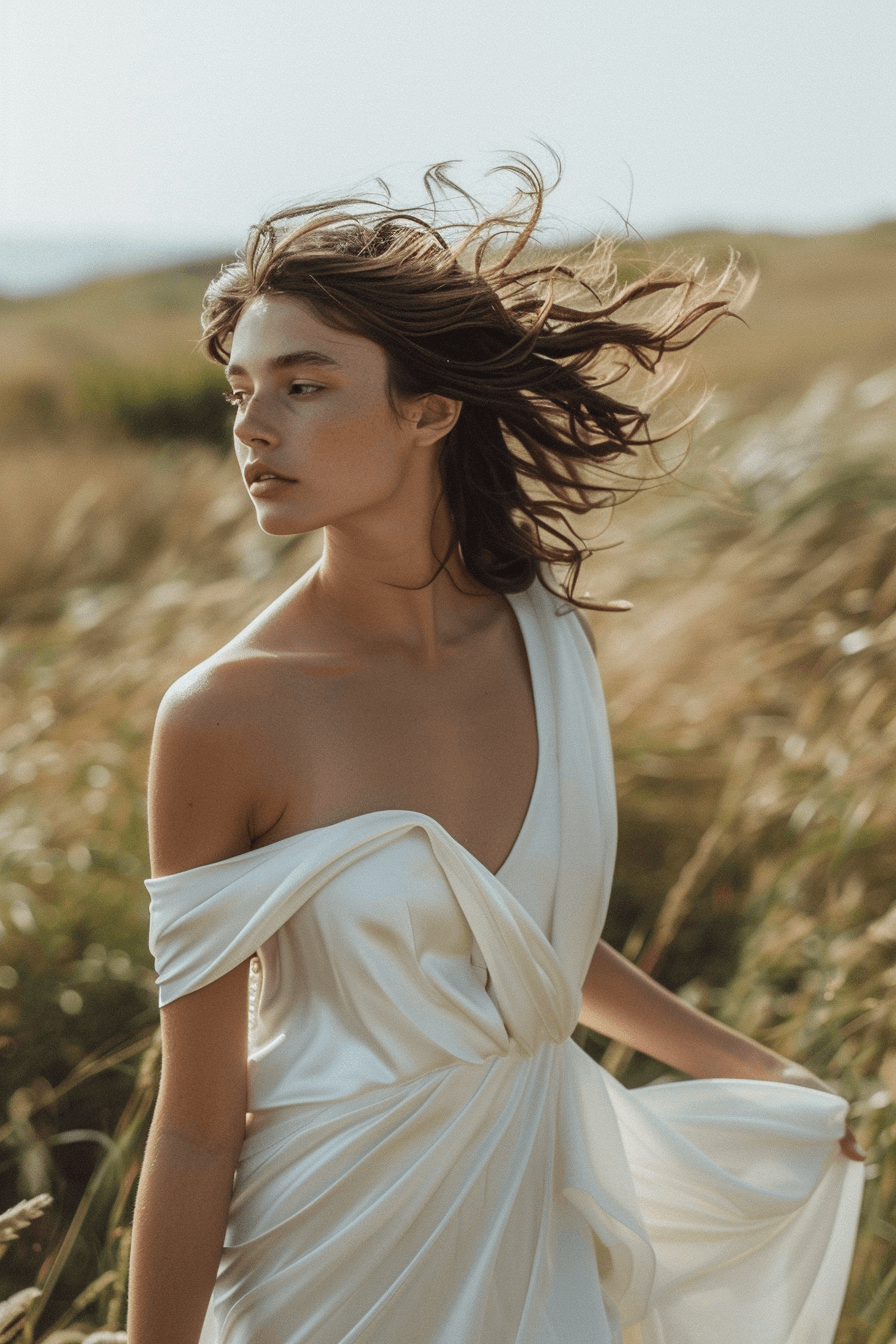
She chooses the dress first. Falls in love with it, actually. The silhouette, the neckline, the way it moves when she walks. And then, weeks later—sometimes much later—she starts thinking about her hair.
Almost as an afterthought.
She scrolls. Saves a few Pinterest images. Maybe brings them to her stylist. But something feels slightly… off. Not wrong, exactly. Just not fully aligned.
Because the truth is, your hairstyle isn’t something you add on top of your look.
It’s part of the structure.
And if it doesn’t balance the dress, you can feel it—even if you can’t immediately explain why.
This is where most “wedding hairstyles based on dress” advice falls short. It tells you what matches. What pairs well. What looks cohesive.
But rarely does it talk about balance.
And that’s where everything changes.
Many brides struggle with this balance because of small but critical mistakes. Before choosing your final look, read 7 wedding hairstyle mistakes brides always make and how to avoid them.
The Rule of Balance
If there’s one thing I wish every bride understood before her trial, it’s this:
Your hairstyle doesn’t need to match your dress.
It needs to balance it.
That sounds simple, but in practice, it’s incredibly nuanced.
Every dress creates a visual weight. Sometimes it sits at the neckline. Sometimes at the shoulders. Sometimes lower, through volume or structure.
Your hair either supports that weight—or competes with it.
Let’s say you’re wearing a very structured bodice with a clean neckline. If you add a heavy, overly styled hairstyle on top, the whole look starts to feel crowded. Nothing has space to breathe.
On the other hand, if your dress is soft, fluid, and minimal—and your hair is equally soft and understated—you risk disappearing into your own look.
During bridal trials, this is often the moment when things shift. A bride looks in the mirror and says, “It’s pretty… but something’s missing.”
What’s missing is contrast. Or sometimes restraint.
Balance is about knowing when to add and when to pull back.
A few subtle principles I always come back to:
- If the dress has strong structure, the hair should soften it.
- If the dress is minimal, the hair can carry more presence.
- If the neckline draws attention upward, the hair should guide the eye—not block it.
It’s less about rules and more about tension. A quiet dialogue between fabric and hair.
And once you start seeing it that way, everything becomes clearer.
Balance doesn’t only depend on the dress—it also depends on your face shape. Explore the ultimate face shape bridal hairstyle guide to refine your choice.
Strapless Dresses: When Everything Is Exposed
A strapless dress does something very specific.
It opens up the entire upper body.
Your shoulders, collarbones, neck—everything becomes part of the visual composition. There’s nothing interrupting that space.
Which is exactly why so many brides instinctively choose to wear their hair down.
And sometimes, that works.
But often, it creates an imbalance.
Because when hair falls forward onto the shoulders, it fills the very space the dress is trying to highlight. The clean openness gets lost. The neckline disappears.
What usually goes wrong is this:
Too much hair, in the wrong place.
Instead of enhancing the silhouette, it competes with it.
A better approach is to think in terms of placement, not just style.
Hair doesn’t have to be fully up—but it should respect the openness of the neckline.
Pulling the hair slightly back, even partially, allows the shoulders to stay visible. A low, soft structure at the back can add shape without closing everything off.
Or, if you prefer wearing it down, consider directing the hair away from the front. Tucked behind the ears, or styled to fall more toward the back rather than forward.
The goal isn’t to hide the hair.
It’s to let the dress breathe.
If you prefer wearing your hair down with strapless dresses, you can explore wedding hairstyles for long hair for more flowing and balanced looks.
Off-Shoulder Dresses: Softness with Intention
Off-shoulder dresses are different.
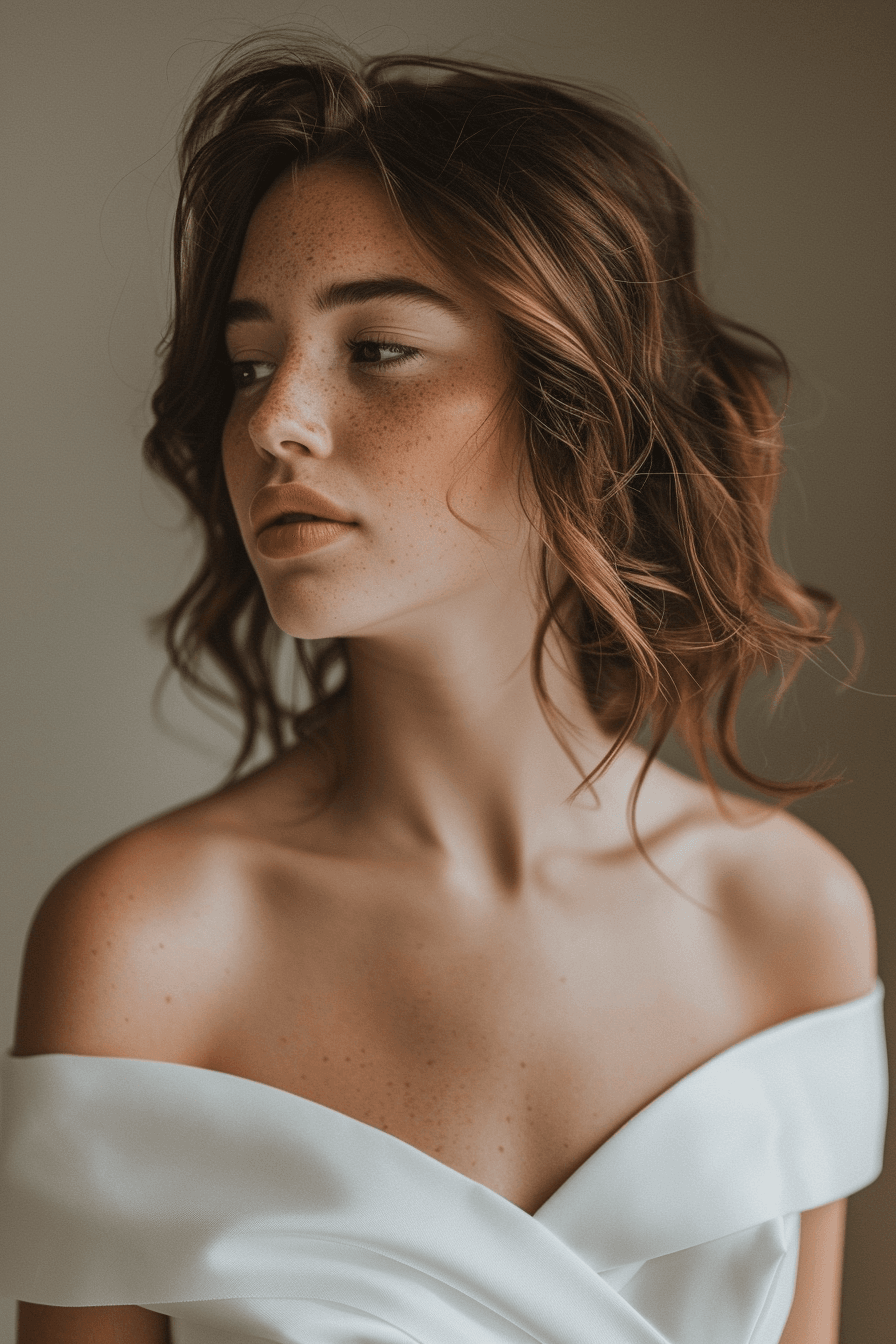
They don’t just expose the shoulders—they frame them.
There’s already a softness built into the design. A curve. A line that sits gently across the arms.
And because of that, the hair needs to be handled with a bit more sensitivity.
What often happens is that brides lean too far into the romantic idea. Loose waves, volume, softness everywhere.
And while that sounds beautiful, it can become visually repetitive.
Soft dress. Soft hair. Soft structure.
Nothing stands out.
The result isn’t wrong—it’s just… forgettable.
This is where contrast becomes your best tool.
Not harsh contrast, but subtle variation.
If the dress already has a curved, draped neckline, your hair can introduce a slightly more defined element. That might be through shape—a controlled half-up style, for example—or through direction, pulling some of the hair away from the face to create space.
Another small but powerful detail: where the volume sits.
Too much volume at the sides can overwhelm the neckline. Instead, lifting slightly at the crown or keeping the sides more refined can shift the entire balance of the look.
It’s not about making the hair “less romantic.”
It’s about giving the romance structure.
Soft textures work beautifully here, but structure matters. You can explore wavy bridal hairstyles guide for balanced movement.
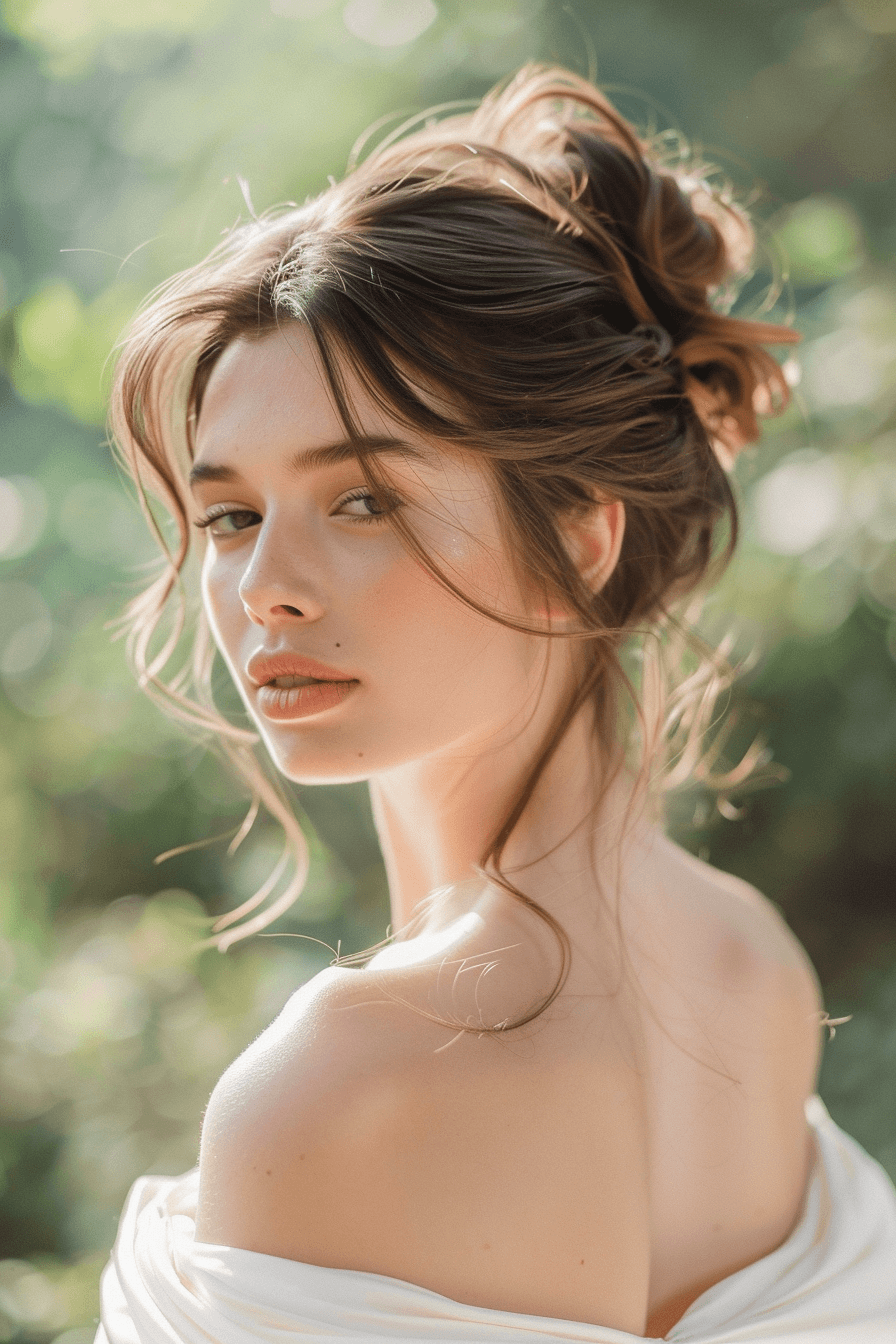
High Neck Dresses: Letting the Neckline Speak
High necklines are often misunderstood.
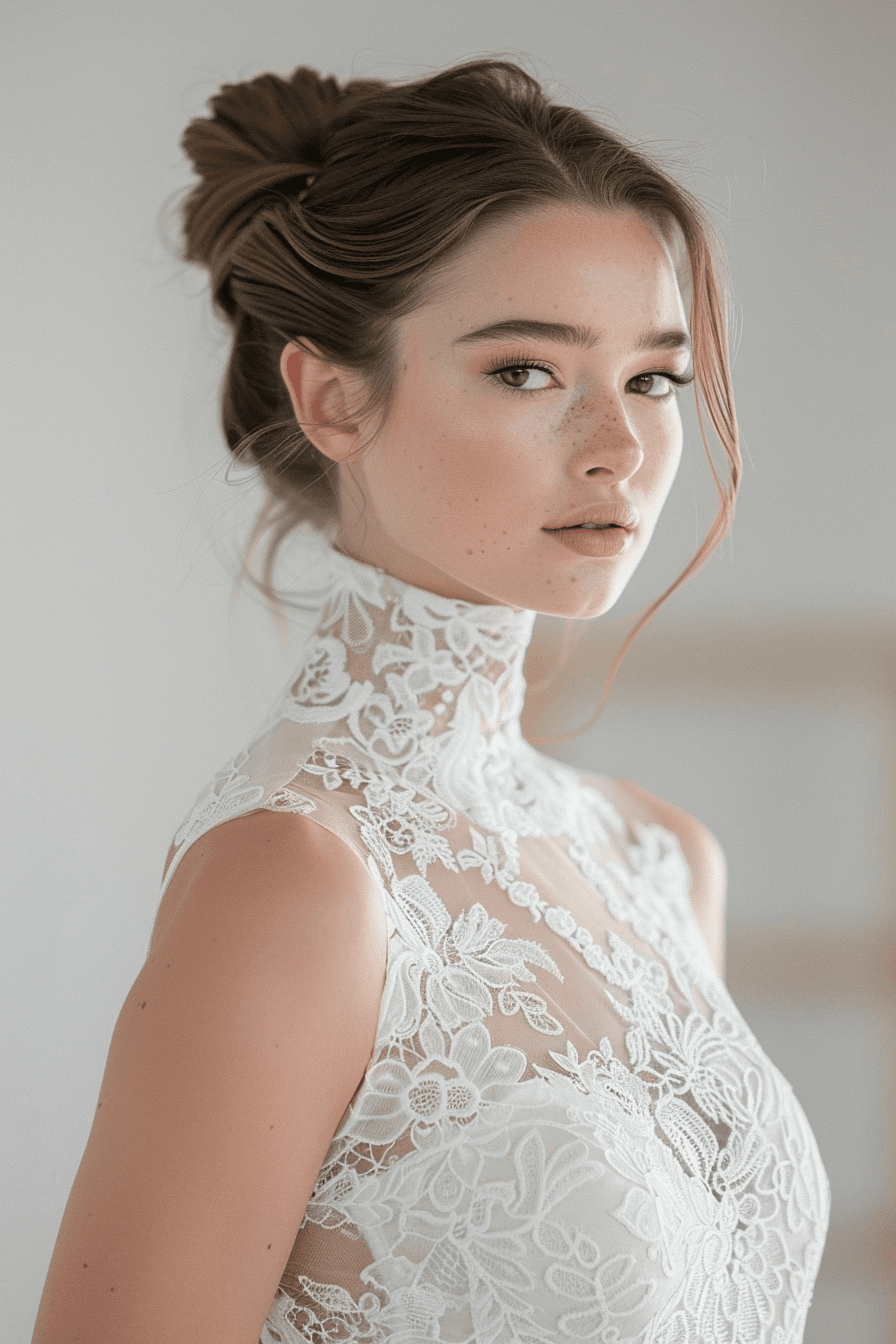
They’re striking. Architectural, even. Whether it’s lace, satin, or sheer fabric, they create a strong vertical line that draws the eye upward.
And yet, many brides instinctively add more around that same area.
Hair down. Volume at the sides. Movement near the neckline.
Which ends up hiding the very feature that makes the dress special.
When you’re wearing a high neck dress, the neckline is already doing the work.
Your hairstyle should step back.
This doesn’t mean your hair has to be severe or overly sleek. It simply means it shouldn’t sit on top of the neckline.
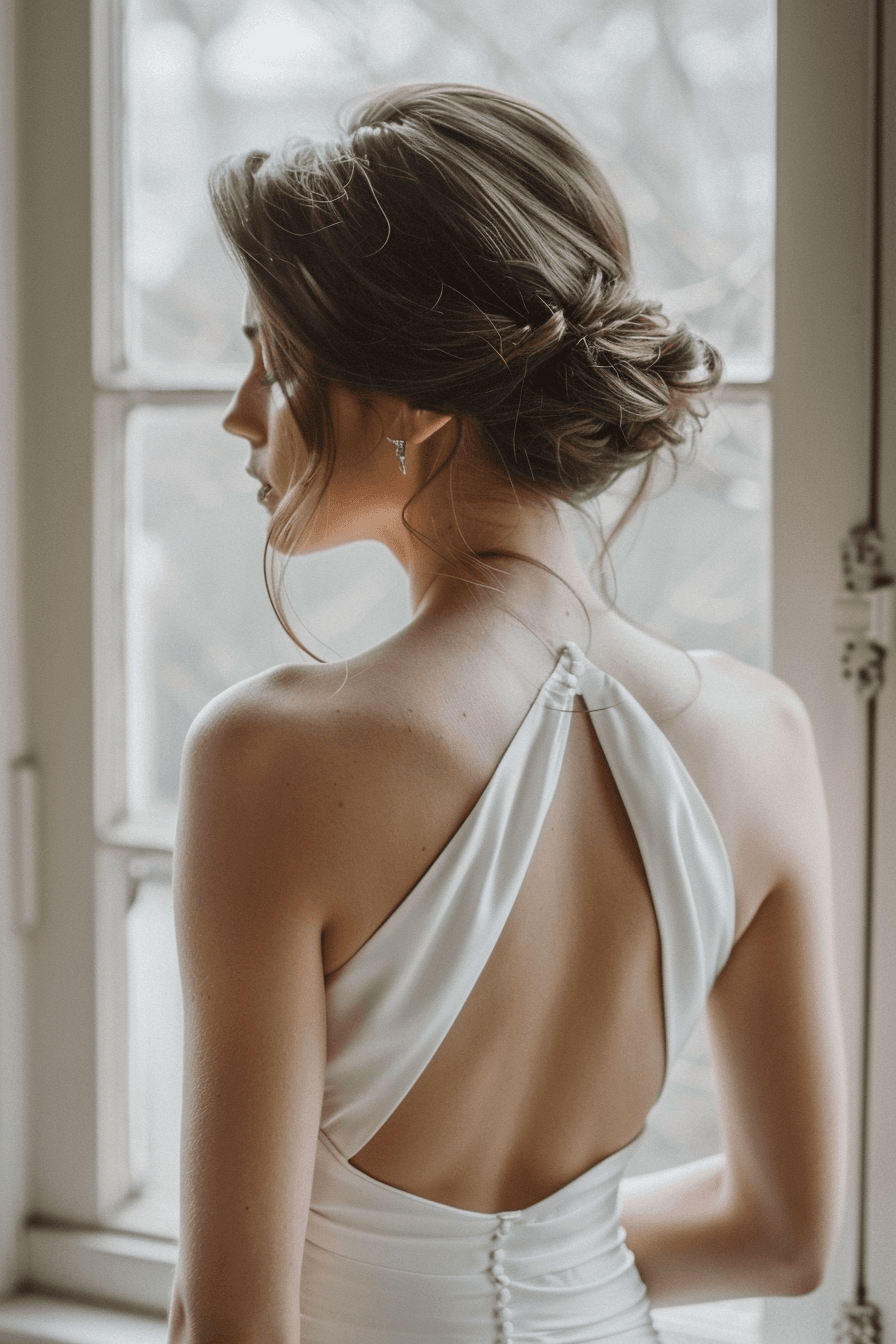
Pulling the hair away from the neck—whether into a low knot, a refined ponytail, or a soft updo—creates clarity. It allows the lines of the dress to remain visible.
There’s also something incredibly modern about this approach.
It feels intentional. Clean. Slightly fashion-forward without trying too hard.
One thing I often mention during fittings:
If you can see the neckline clearly from every angle, you’re on the right track.
For clean and structured looks that complement high necklines, explore sleek low bun wedding hairstyles.
Deep V Neck Dresses: Following the Line Without Copying It
A deep V neckline introduces direction.
It draws the eye downward, creating a vertical movement through the center of the body. It can be sharp and dramatic, or soft and fluid depending on the fabric.
The instinct here is often to mirror that line with the hair.
Center parts. Symmetry. Hair falling evenly on both sides.
And while that can work, it can also become too predictable.
Too expected.
The more interesting approach is to respond to the neckline, not replicate it.
For example, if the dress creates a strong downward line, your hair can introduce a counterbalance. A slight asymmetry. A shift in volume. Something that breaks the perfect symmetry just enough to feel natural.
Another consideration is where the focus sits.
A deep V already draws attention to the center. If your hair also falls heavily into that same space, it can feel crowded.
Pulling some of the hair away—either through a half-up style or by directing the lengths slightly backward—creates breathing room.
It allows the neckline to stand out without competition.
And that’s really what all of this comes back to.
Not matching.
Not copying.
But understanding where the eye goes—and guiding it with intention.
Deep V necklines are already expressive. They don’t need reinforcement. They need space.
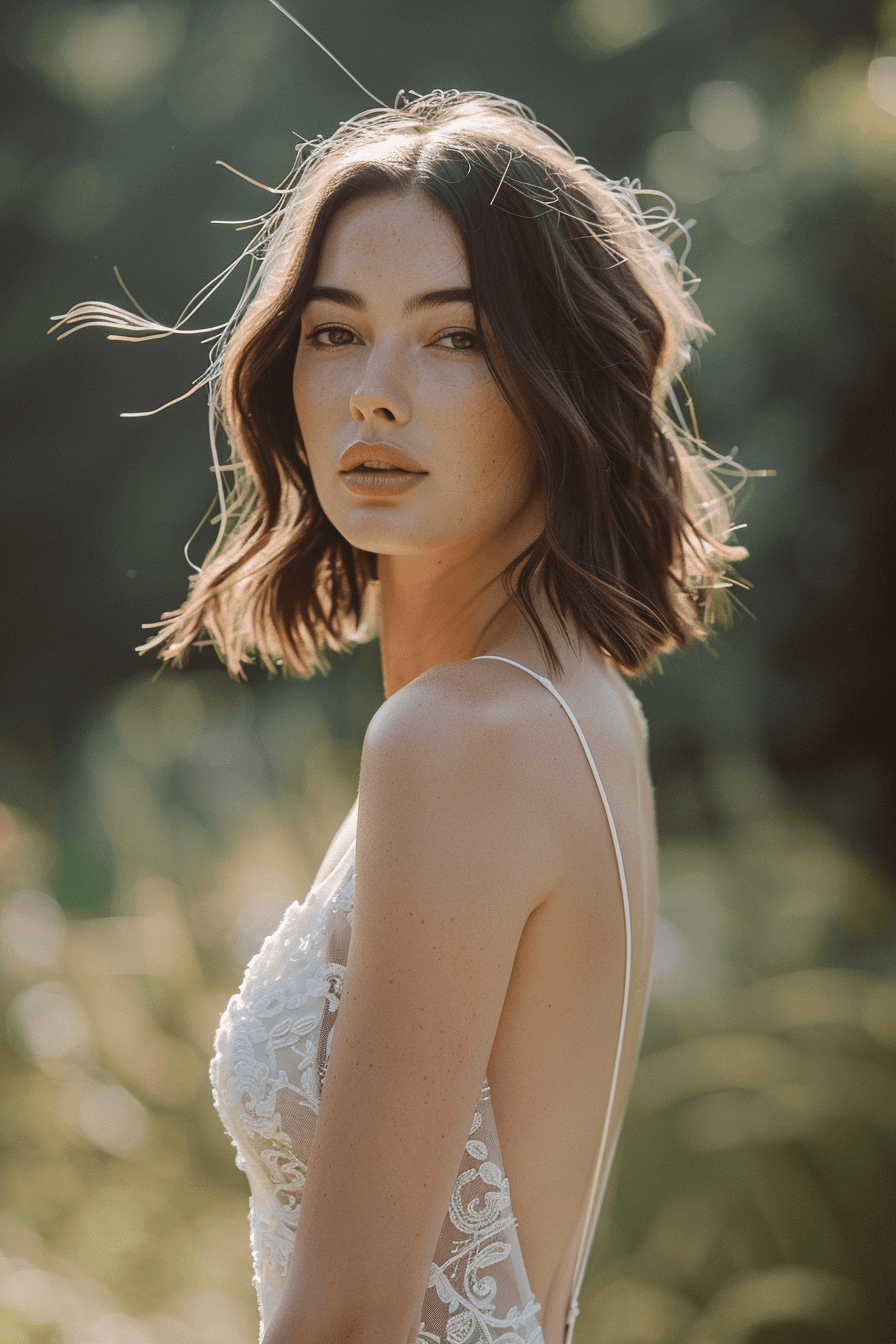
Halter Neck Dresses: Clean Lines, Quiet Confidence
Halter necklines carry a certain confidence.
They frame the shoulders in a very deliberate way, often elongating the neck and drawing attention upward. There’s something slightly sporty about them, but also incredibly refined—especially in silk or crepe.
The mistake I see most often?
Hair that falls exactly where the neckline wants attention.
Loose lengths sitting on the shoulders, breaking that clean line. It softens the effect—but not always in a good way.
With halter styles, clarity is everything.
When the hair is lifted—whether into a low bun, a structured ponytail, or even a softly undone updo—the neckline becomes sharper, more defined. You see the full intention of the dress.
That doesn’t mean it has to feel strict.
A few loose pieces, a slightly imperfect finish, or a natural texture at the crown can keep the look from becoming too controlled. Especially for brides who don’t want anything overly polished.
What matters is this:
The neck and shoulders should remain visible.
Because that’s where the dress is speaking.
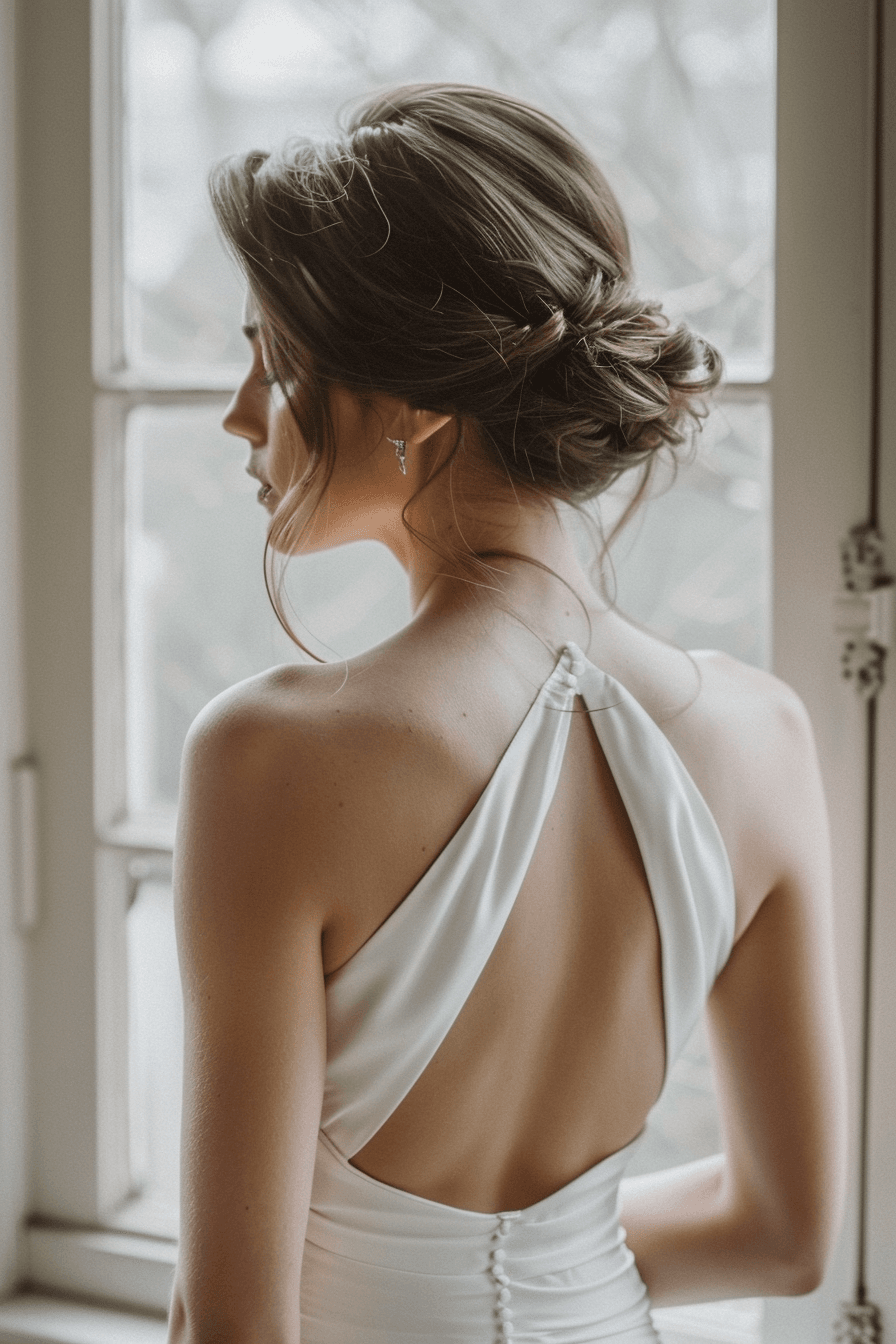
One-Shoulder Dresses: Embracing Asymmetry
A one-shoulder dress already creates movement.
There’s an inherent asymmetry—one side open, the other structured. It draws the eye diagonally across the body, which is incredibly flattering when styled well.
But it also means your hair can’t be an afterthought.
The most common misstep is going too symmetrical. Center-parted waves, evenly distributed volume—it flattens the dynamic of the dress.
Instead, the hair should echo that asymmetry.
Not in an obvious way. Just enough to feel intentional.
For example, sweeping the hair to one side—often the opposite of the strap—can create a subtle balance. It opens up one shoulder while adding softness to the other.
Or, if you prefer an updo, consider a style that isn’t perfectly centered. A low knot slightly off to one side can mirror the dress without copying it directly.
This is where styling becomes almost architectural.
You’re not just choosing a hairstyle—you’re shaping how the eye moves across your body.
And when it’s done well, it feels effortless.
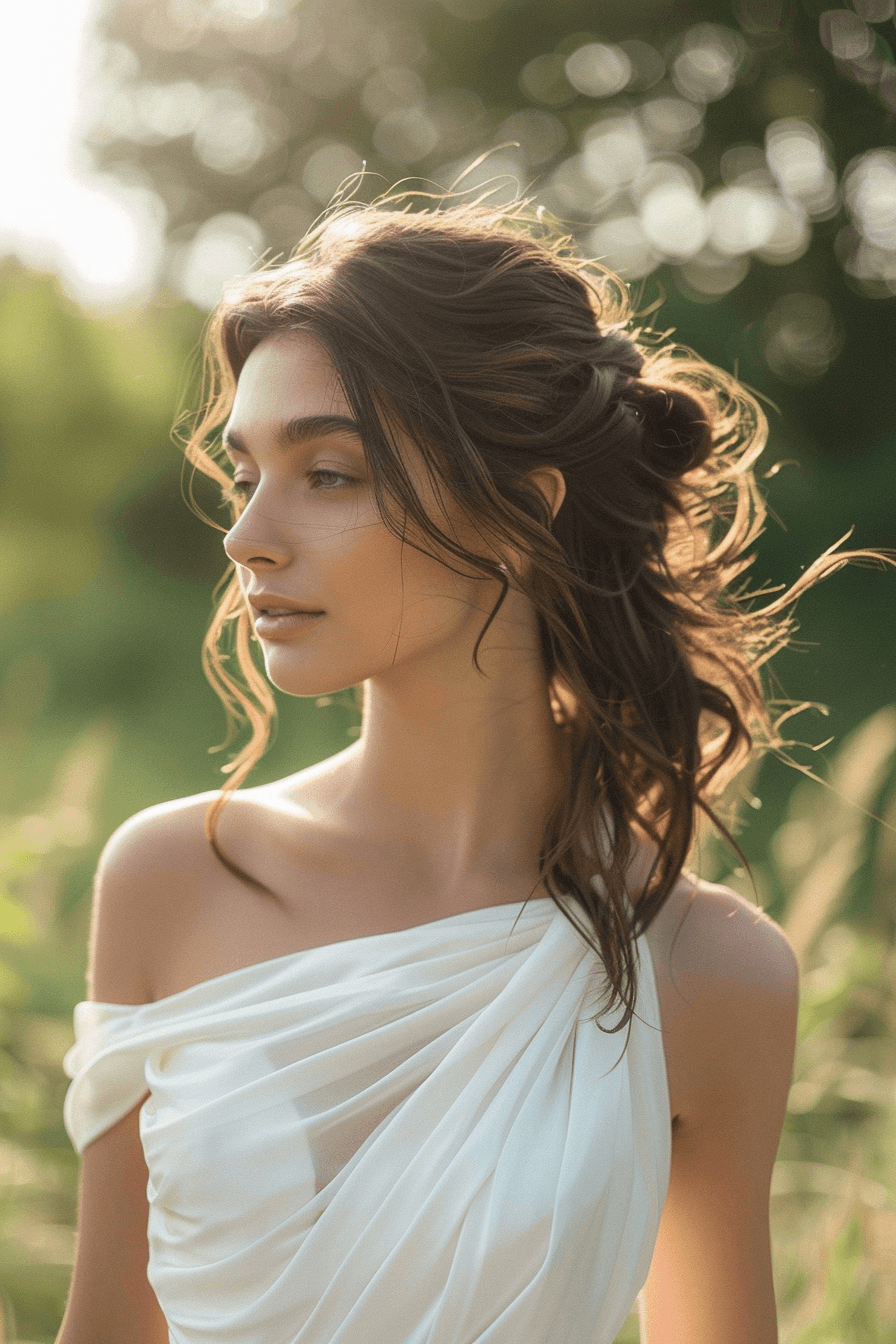
Backless Dresses: The Power of What’s Behind You
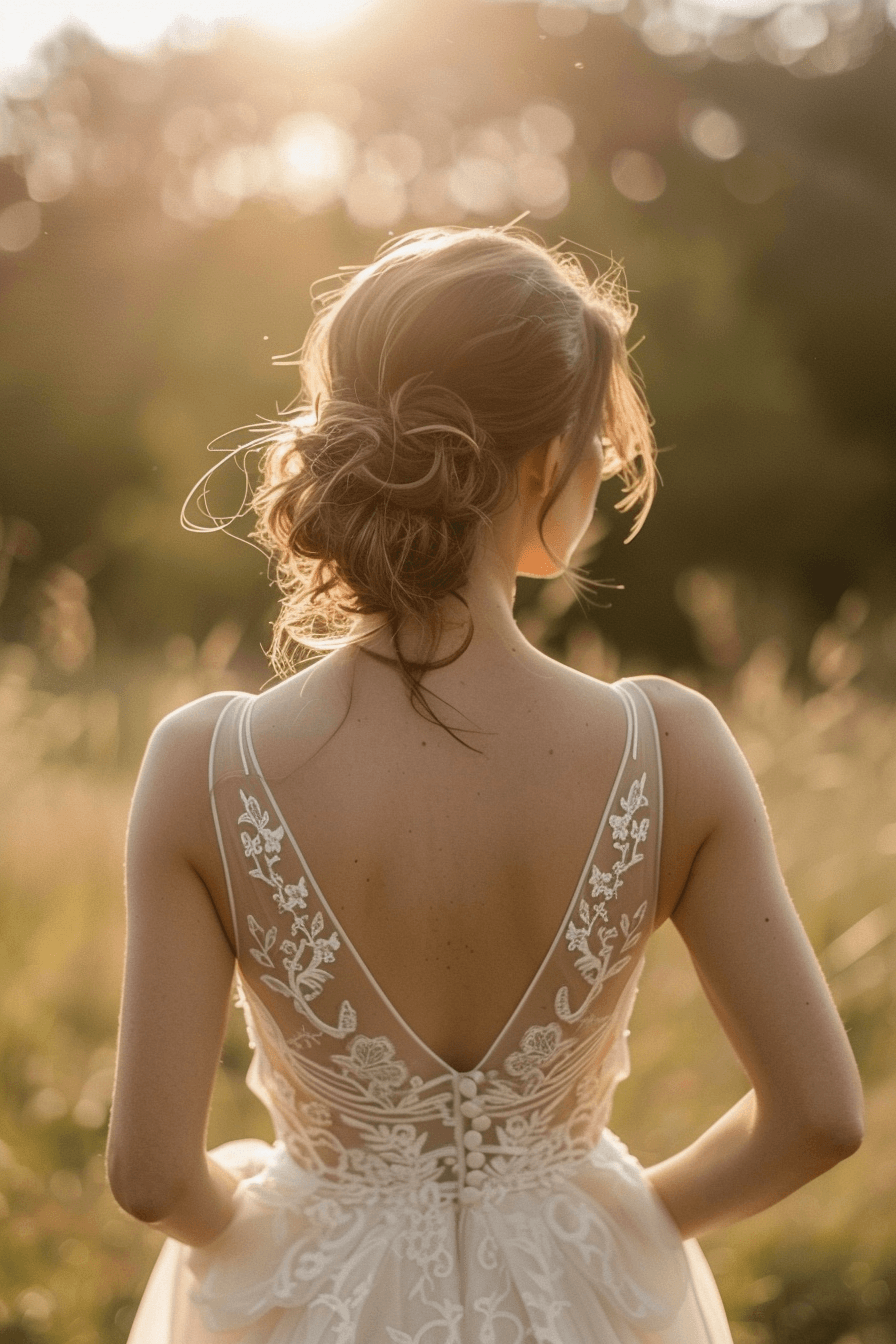
Backless dresses are less about the front—and entirely about the back.
They reveal just enough to feel unexpected. A glimpse of skin, a delicate line, sometimes intricate detailing that only shows when you turn.
And yet, this is where many brides lose the impact.
Hair down. Volume covering the back. Movement that hides the very feature the dress is built around.
It’s understandable—wearing your hair down feels safe. Familiar.
But with a backless dress, it often means giving up one of the most striking elements of your look.
Pulling the hair away from the back—even partially—can completely transform the silhouette.
A low bun, a braided structure, or even a soft half-up style that keeps the center clear allows the back to remain visible.
One small detail I always mention:
Think about how your hair looks when you walk away.
Because that’s often the moment people remember.
If you want to keep the back visible while maintaining a modern feel, you might also like short wedding hairstyles.
Ball Gowns: When Volume Meets Volume
Ball gowns carry weight. Not just physically, but visually.
Full skirts, structured bodices, layers of fabric—they create presence.
And because of that, many brides feel they need to “match” that energy with equally dramatic hair.
Big curls. High volume. Statement styling.
But when both the dress and the hair compete for attention, the result can feel overwhelming.
Too much happening at once.
With voluminous dresses, the key is control.
Not necessarily simplicity—but intention.
A softer, more contained hairstyle can actually elevate the entire look. It gives the dress space to shine, while still feeling considered.
That might mean a structured low bun with gentle texture. Or controlled waves that don’t expand too far outward.
Think of it like this:
If the dress is already making a statement, your hair doesn’t need to shout.
It just needs to support.
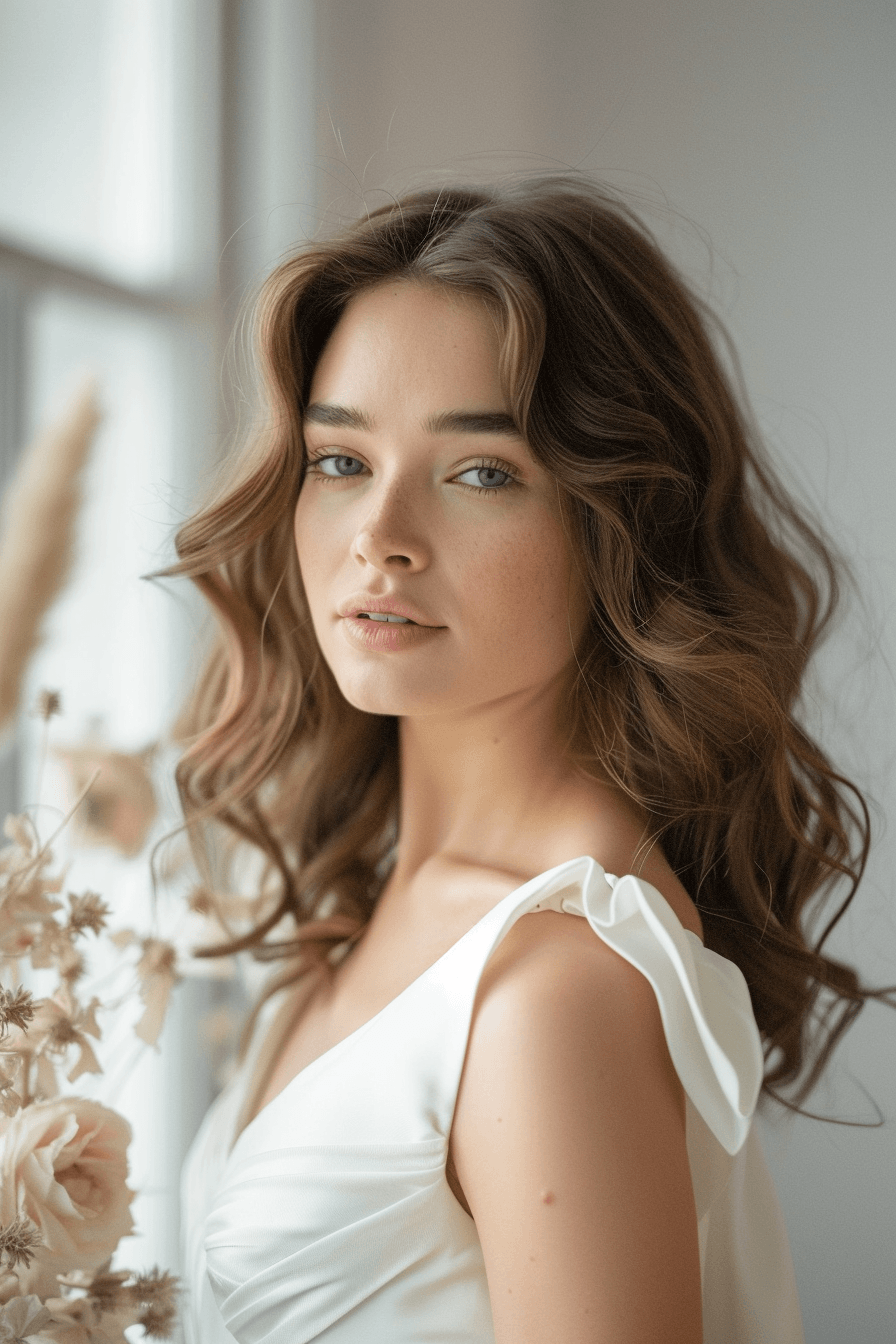
The Overstyling Problem
There’s a point in almost every bridal trial where things start to feel… too much.
Another curl. A bit more volume. A stronger hold spray.
And suddenly, the hair stops moving the way it should.
Overstyling doesn’t always look obvious in the moment. In the mirror, everything seems polished. Finished.
But in real life—and especially in photos—it can feel stiff. Slightly disconnected from you.
The irony is that most brides aren’t trying to overdo it.
They’re trying to make sure it lasts.
And that’s valid.
But longevity shouldn’t come at the cost of natural movement.
Hair should respond when you turn your head. It should shift slightly when you walk. It should feel like something you can forget about—not something you’re constantly aware of.
One thing I often say during trials:
If you can feel your hairstyle too much, it’s probably doing too much.
The most beautiful bridal hair doesn’t look constructed.
It looks like it belongs to you.
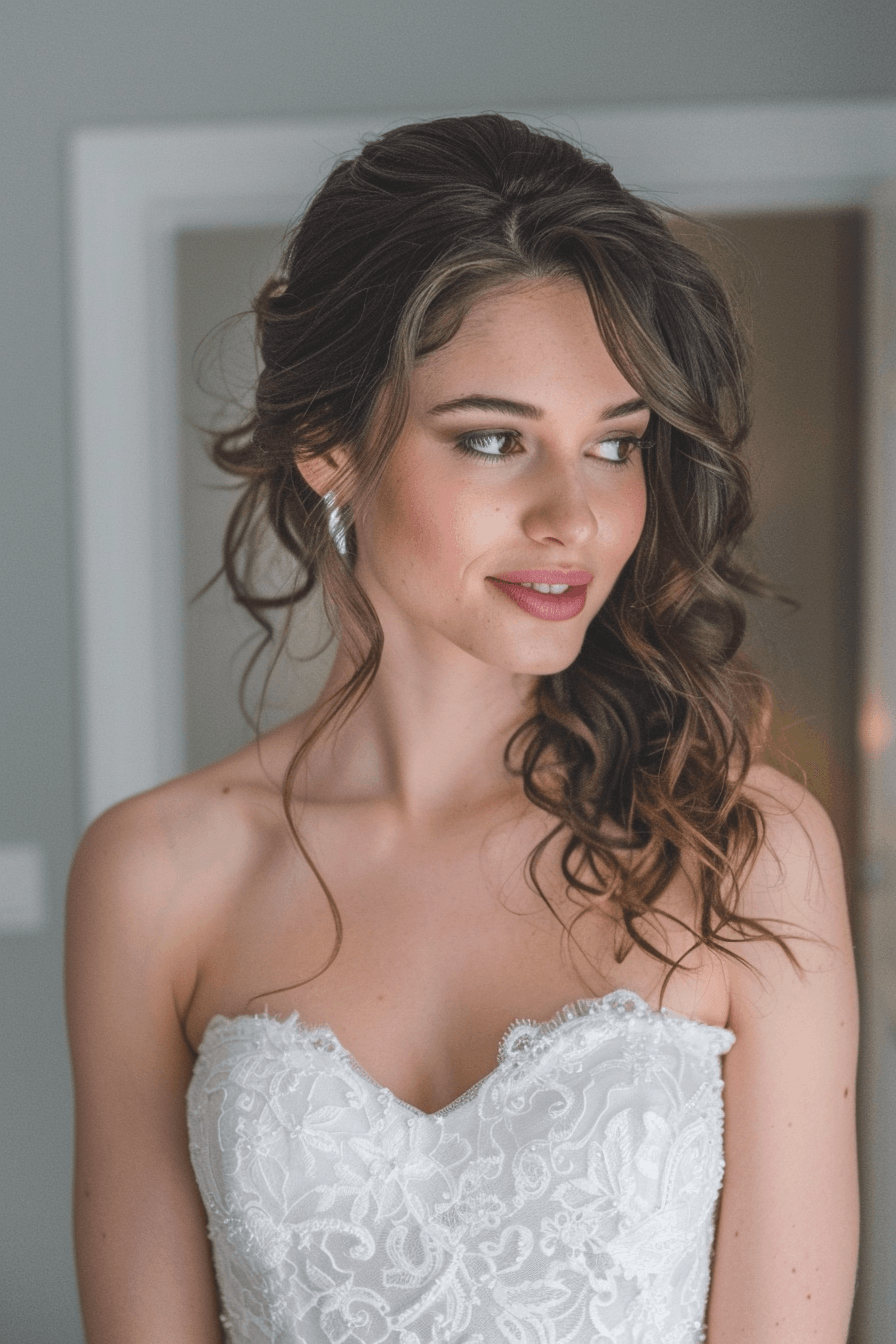
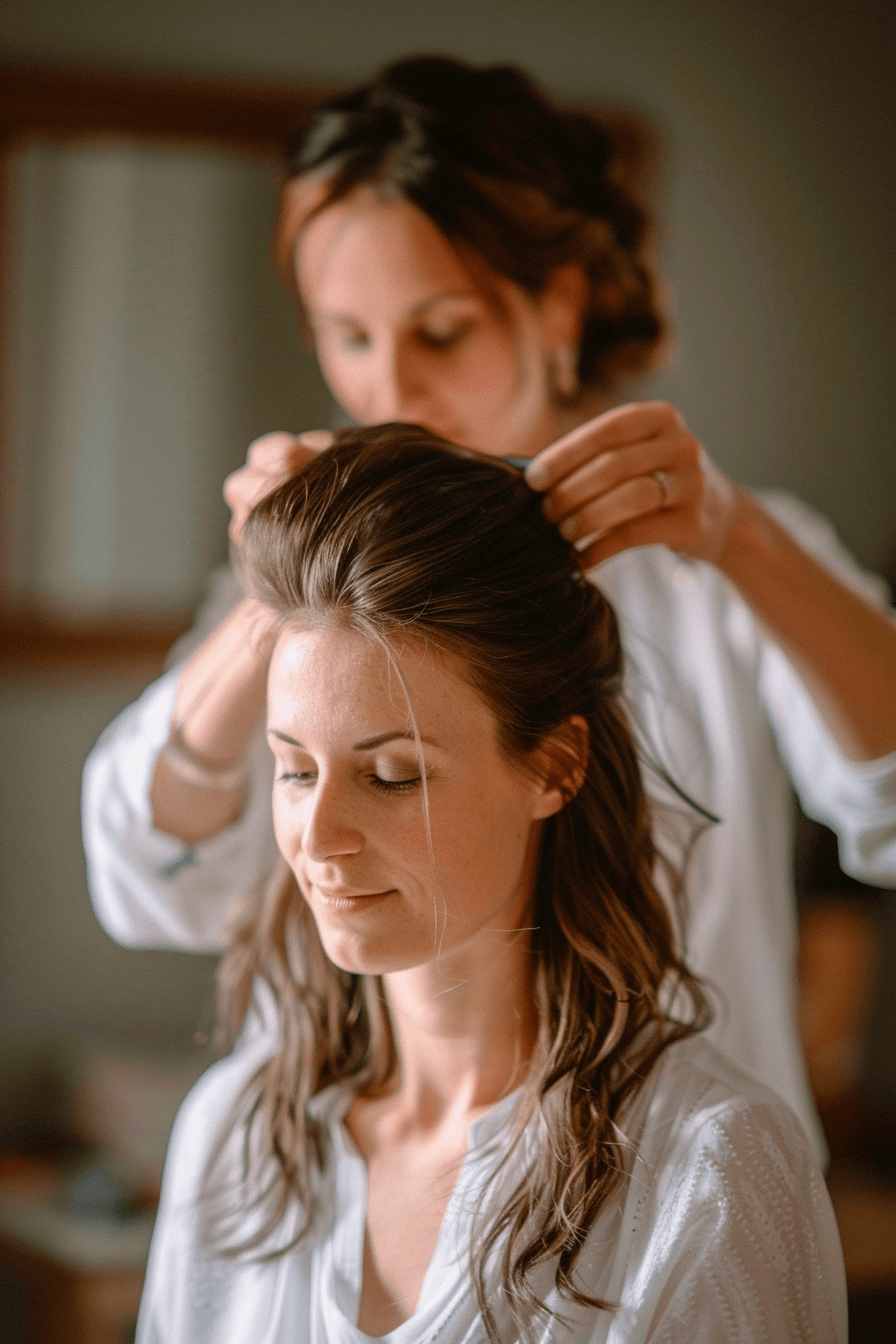
How to Test the Look During Your Bridal Trial
A trial isn’t just about choosing a hairstyle.
It’s about understanding how that hairstyle lives on you.
And that requires a bit more intention than simply sitting in the chair and saying, “I like this.”
Try this instead.
Move.
Turn your head from side to side. Look down. Look up. Notice how the hair shifts. Does anything fall out of place? Or does it move naturally and settle back?
Step away from the mirror.
Sometimes we get used to seeing ourselves head-on. But your guests won’t see you that way. Ask for a handheld mirror. Look at the back. The sides.
Take photos.
Not just posed ones. Candid angles. Slightly messy moments. That’s where you’ll see how the hairstyle really behaves.
And most importantly—sit with it.
Don’t rush the decision. The right hairstyle doesn’t just look good. It feels comfortable. Familiar, even.
Like something you don’t have to think about.
Final Thoughts
Choosing your bridal hairstyle isn’t about finding the “perfect” match for your dress.
It’s about creating balance.
About understanding how fabric, shape, and movement interact—and letting your hair become part of that conversation.
The most compelling bridal looks aren’t the ones that follow rules.
They’re the ones that feel considered.
Where nothing is competing. Nothing is forced.
Just a quiet harmony between everything you’re wearing—and the way you carry it.
And when that balance is right, you don’t just look like a bride.
You look like yourself, at your best.
No matter your dress or hairstyle, the key is making it last all day. Don’t miss this complete guide on how to make your wedding hairstyle last all day.